Round, not square: biodomes, curved buildings and why nature has so few boxes
Nature builds in curves, spirals and domes. We built our world in rectangles. Here is the case for building round, what the Eden Project, Biosphere 2 and Gardens by the Bay actually teach us, and what the evidence says about living near nature.
In this story
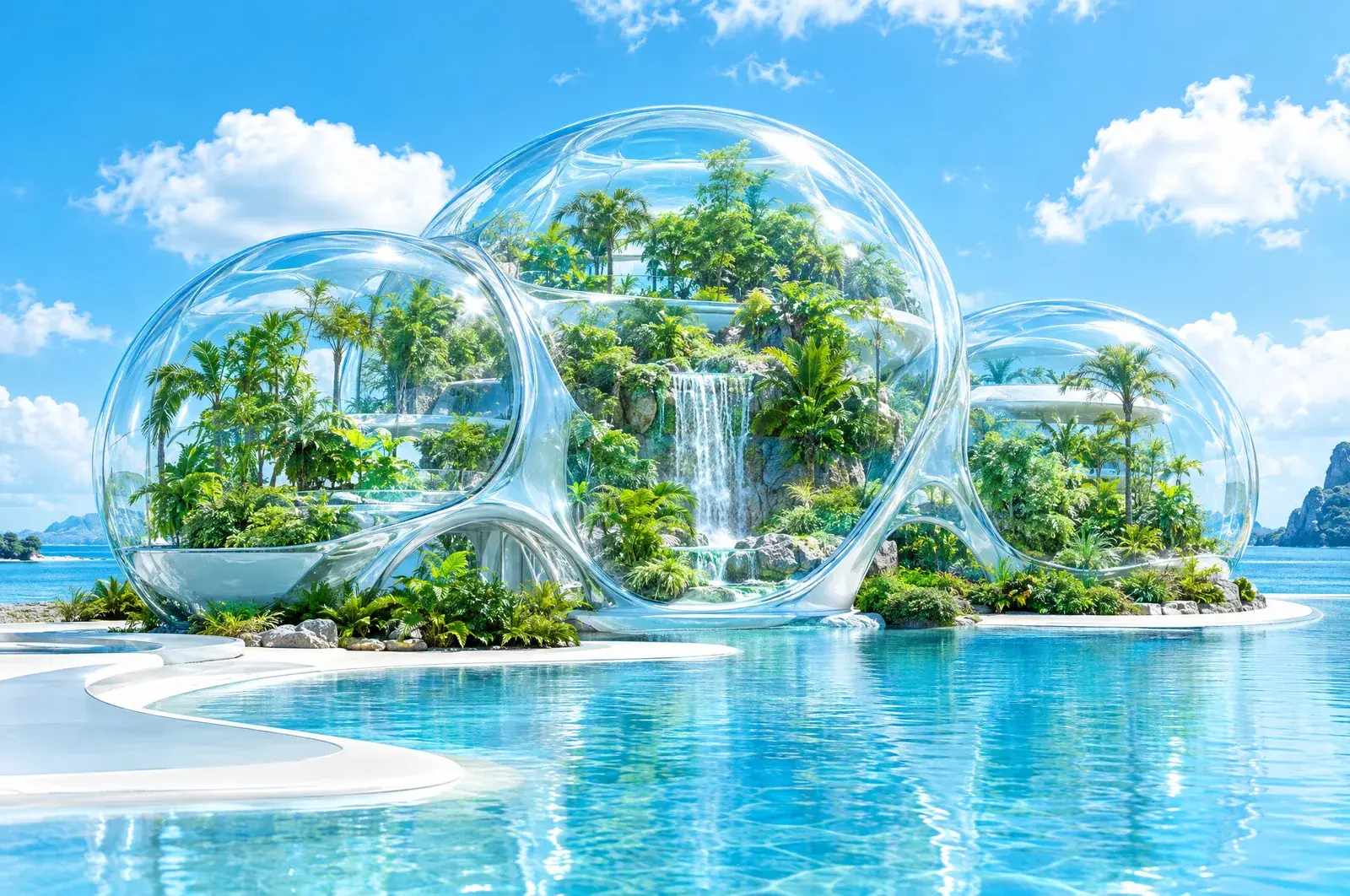
Look out of a window at anything a person has not built, and you will find very few straight lines and almost no boxes. Bubbles, waves, leaves, shells, hills, clouds: nature works in curves. Our cities mostly do not. That is worth questioning, and there are real buildings that already do.
I like round things, and I like them for more than looks. A curve gives the eye somewhere to travel, a corner gives it somewhere to stop. Living in a world of grids and boxes is a bit like living inside a spreadsheet, and a fast, associative mind does not think in cells. It thinks in webs, spirals and loops. So I wanted to look at what rounded, nature-shaped building really is, what it can and cannot do, and where you can see it.
Why curves make sense
Some of this is plain geometry.
- A sphere holds the most space for the least surface. Of all shapes, a sphere has the smallest surface area for a given volume. That is why soap bubbles are round: the film pulls itself into the shape that uses the least material.
- Domes and arches carry load well. A curved shell spreads weight along its curve, so it can span a large space with a thin structure. That is why old cathedrals and modern glass domes both use curves.
- Curves shed wind and rain. A rounded shape gives air and water an easy way round.
I should be honest about the other side. Nature is not free of straight lines: crystals, tree trunks and horizons have them. And boxes are popular for good reasons. They are cheap to design, easy to stack, easy to furnish, and easy to price. Curved buildings usually cost more to design and build, and standard fittings do not fit them. So the argument is not that every building should be a bubble. It is that the box has been the default for so long that we stopped noticing it was a choice.
Three real domes, and what they teach
The Eden Project, Cornwall
Opened in March 2001 in a former clay pit, the Eden Project is a set of linked geodesic domes, called biomes, designed by the architect Nicholas Grimshaw's practice. Its cladding is made of transparent pillows of a plastic foil called ETFE, arranged in hexagons and pentagons, which is very light for its size. The biomes hold plants from tropical and warm-temperate regions, and the site received almost two million visitors in its first year, according to summaries such as the Wikipedia article on the Eden Project and the architects' own page.
The lesson: a curved, light, transparent structure can grow a rainforest in England. It also became an ordinary, much-loved place to visit, which is the real test of any building.
Biosphere 2, Arizona
Biosphere 2 is a three-acre glass-and-steel structure in the Arizona desert. On 26 September 1991, eight people, four men and four women, sealed themselves inside it for two years to see whether a small closed ecosystem could support them. Oxygen fell from about 20.9% at the start to about 14.2% after 17 months, and the team had to pump in oxygen from outside in 1993. Later analysis pointed to soil microbes using up oxygen. Summaries include the Wikipedia article on Biosphere 2 and EBSCO's research starter.
The lesson: this is the one I find most valuable, and it is a lesson in humility. Nature is a far more complicated machine than the drawings suggest. A beautiful sealed dome is not automatically a working ecosystem. Anyone who tells you that we can simply copy nature in a bubble has not read this story. It is also why the rest of this post is about learning from nature, not replacing it.
Gardens by the Bay, Singapore
Opened in summer 2012, Gardens by the Bay includes two cooled conservatories designed by Wilkinson Eyre: the Flower Dome, with a cool, dry Mediterranean climate, and the Cloud Forest, a cool, moist environment with a tall indoor waterfall. They cover 16,500 square metres and are described as designed to run with low-energy and renewable systems. They won the RIBA Lubetkin Prize in 2013, and were named World Building of the Year in 2012, per the architects' project page and the Architects' Journal.
The lesson: a dome can be a public place, not just a laboratory. Millions of people can walk through a cloud forest in the middle of a city, and that changes what they think a city can be.
What living near nature does for people
The case for rounded, plant-filled buildings does not rest on how they look. There is a long line of research on how nature affects people, and I want to give you the best-known study and its limits.
In 1984 Roger Ulrich published a study in Science looking at patients who had had gallbladder surgery in a Pennsylvania hospital. He compared 23 patients whose rooms looked out on trees with 23 matched patients whose windows faced a brick wall. The patients with the tree view had shorter hospital stays, fewer negative comments in the nurses' notes and took fewer strong painkillers. You can read the abstract of the study.
It is a small study of one hospital, and it is from the 1970s and 80s, so I would not build a theory on it alone. But it has been widely discussed ever since, and it fits a wider pattern. A 2024 systematic review and meta-analysis found that access to gardens was associated with lower odds of depression and anxiety, and more time in green spaces with lower stress. The authors rated the overall quality of the evidence as very low, because there were few studies and a high risk of bias, so I read it as a reasonable hint that is worth testing, not as settled fact.
What "round" means beyond buildings
I like the idea for another reason. A grid is a way of thinking as much as a way of building. Boxed thinking says: this goes in that category, this is either right or wrong, this person is one type. Round thinking says: things overlap, and one thing can be two things, and the edges are soft.
That is very close to how an ADHD or AuDHD mind works, and I think we spend a lot of energy squeezing it into square forms: rigid timetables, rigid roles, rigid definitions of a "productive" day. I write about the mind side of this in dolphining, the ADHD mind. The point is not that structure is bad. It is that structure works better when it bends.
Bringing roundness in, at any budget
You do not need a dome. Here are practical ways to move a space from boxed toward rounded and natural:
- Put a plant where you look most. Ideally by a window.
- Choose one curved thing. A round table, an arched mirror, a soft-edged lamp.
- Soften the light. Warm-white bulbs, indirect lighting, and daylight where you can get it.
- Open a view. If there is any patch of sky or tree, clear the window.
- Bring in natural materials. Wood, stone, clay, wool, linen.
- Take the walls off a corner. Even a curtain or a screen turns a hard corner into a soft one.
For building with a curve at scale, look at building with earth. Cob and rammed earth are naturally rounded, and they use materials from under your feet.
Where this fits in the bigger picture
Rounded, plant-filled, sunlit buildings are the visual heart of solarpunk, and they are also the look of the Frutiger Aero era: glass, water and sky in soft shapes. Real examples of cities that do some of this exist, described in solarpunk cities that already exist. The technology to power them is getting cheaper, as I show in solar is now the cheapest electricity.
Come and design it with us
If you have ideas for a rounder home, garden or town, or if you have already made a space you love, the ADHD MindFlow community is a friendly place to share it. And when you need a calm mind to start a project, a few minutes with one of the listening sessions helps.
A personal view, with sources linked. Building costs, regulations and safety vary by place, so get local professional advice before you build.
Personal view, with sources linked so you can check the numbers yourself. Read our sources, commercial disclosure and editorial approach.
Follow your curiosity.
 Nature & technology
Living with AI as a friend, not a threat: what harmony would actually take
I believe AI can be one of the best companions humans have ever had. I also do not know how it will go, and neither does anyone else. Here is my honest view, what the evidence says, and the habits that keep it a friend.
6 min read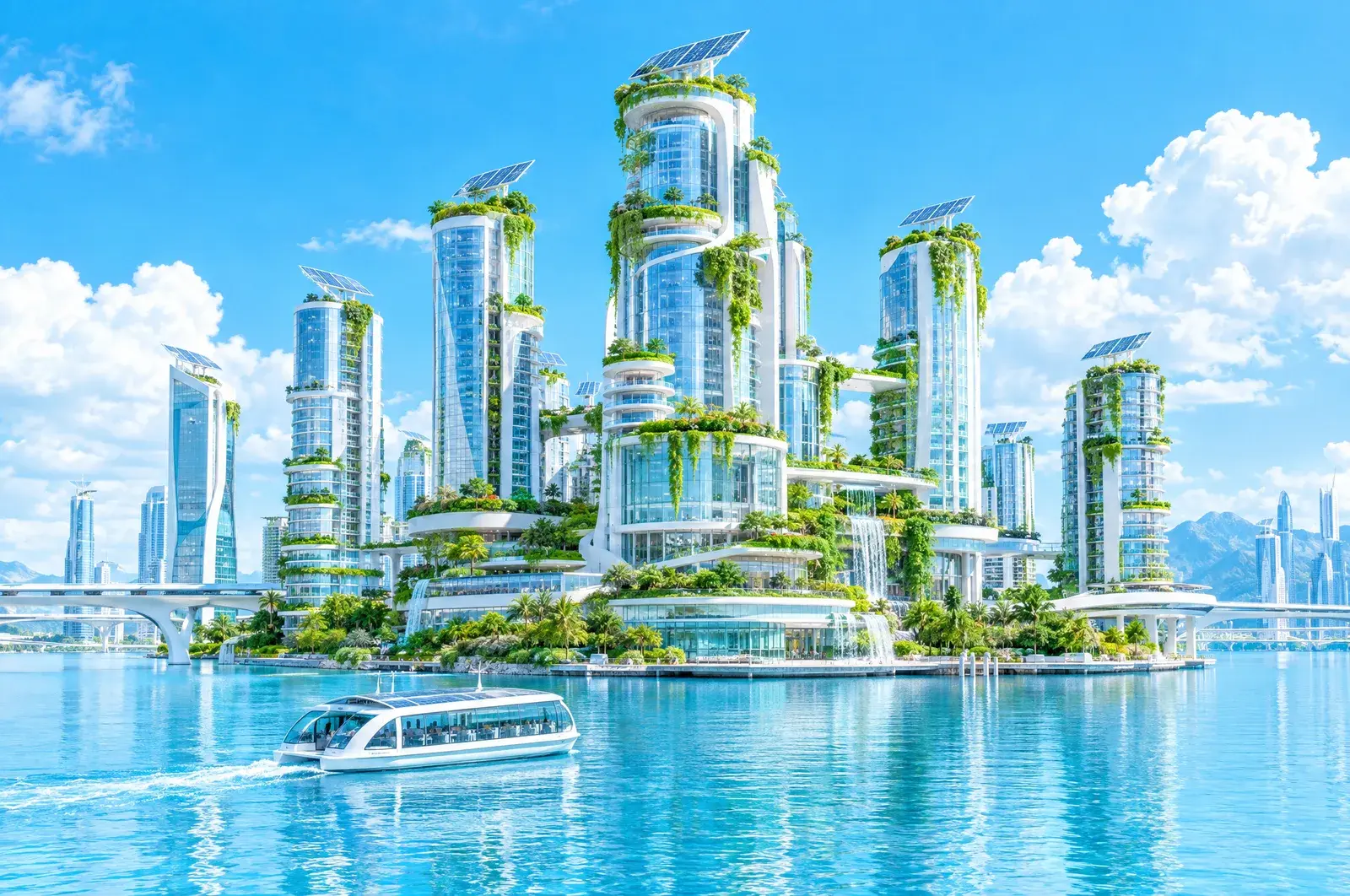 The future
What is solarpunk? The optimistic future, and what is already real
Solarpunk imagines a future where clean energy, nature and community fit together. It began as a 2008 blog post and became an art, fiction and design movement. Here is what it means, what is already real, and where it falls short.
5 min read Energy & home
Solar is now the cheapest electricity we have ever made: the numbers, and their limits
Solar power fell about 90% in cost between 2010 and 2024, and in 2025 renewables overtook coal for the first time in a century. Here are the checked numbers, what they mean, and what they do not.
5 min read