
Solarpunk cities that already exist: Vauban, Copenhagen, Medellín and Curitiba
You do not need to wait for the future to see cities that work differently. Four real places, what they actually did, the numbers reported, and the honest limits of each story.
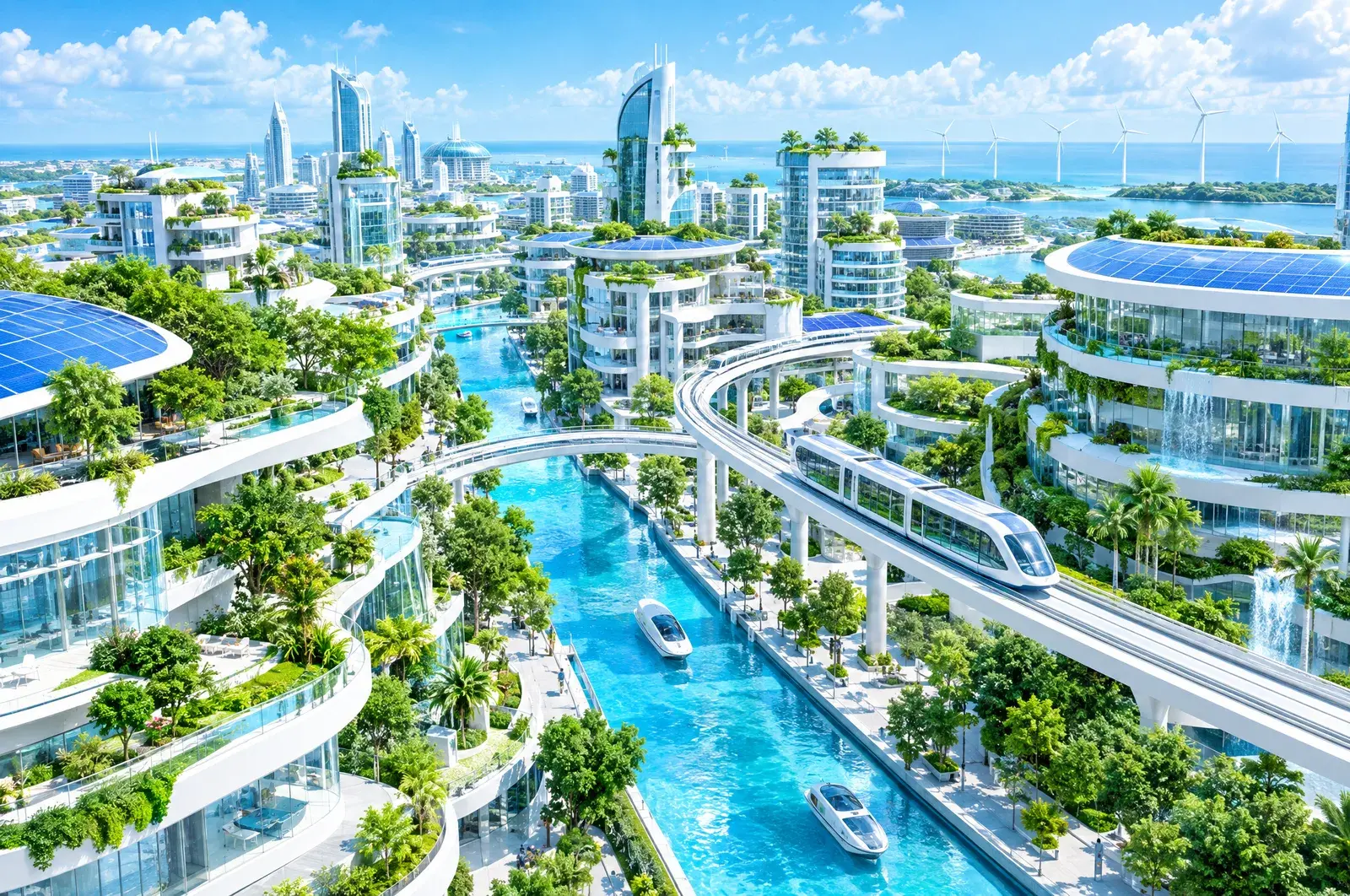
In this story
A future where cities are greener, quieter and easier to live in is not only a drawing. Pieces of it have been built, in different places, for different reasons. Here are four, with what they did and where the story gets more complicated.
When I describe a hopeful city, people sometimes say it sounds nice but impossible. My answer is to point at places. None of these is perfect, and none is a finished utopia. But each is proof that a specific idea, tried at scale, worked well enough to keep.
I have chosen four different ideas: living without a car, moving by bicycle, cooling a city with trees, and moving people by bus in a smarter way. For each I will tell you the reported numbers and the caveats.
Vauban, Freiburg: a neighbourhood built around people, not cars
Vauban is a district on a former military site in Freiburg, in southwest Germany, redeveloped from the 1990s. It is best known for two things. First, it is largely car-free: streets are mostly closed to through traffic and cars are parked at the edge of the neighbourhood, not at the front door. Second, it has a great deal of solar power. Its rooftop panels are a big part of why the area is called a "plus-energy" district, and many homes were built to very high insulation standards. Wikipedia's article on Vauban summarises the design.
The numbers cited for it are striking. As of 2009, roughly 70% of households did not own a car, according to the sources I found. I would treat that as the figure reported for that year and not a permanent fact, because it comes from a study of one moment.
The caveats. Vauban is a single neighbourhood, built on empty land with a strong local movement behind it, in a country with good trains and trams. That is much easier than retrofitting an established, car-dependent suburb. It shows what is possible, and it does not show that it is easy.
Copenhagen: bicycles as ordinary transport
Copenhagen did not become a cycling city by accident. Over decades it built separated cycle lanes, bridges and traffic-light timings that favour bikes. The city publishes a regular Bicycle Account. According to State of Green, summarising it, bicycles now outnumber cars in the central city, and around 49% of all trips to work or school in Copenhagen are made by bike. Among Copenhagen residents alone the share is higher, at about 62%.
Notice how ordinary that is. It is not a sport or a lifestyle, it is how people get to work. That is the "punk" in solarpunk: an everyday behaviour that used to be a fringe choice becoming the default.
The caveats. Copenhagen is flat, compact and has a mild climate for cycling, and Denmark has a long cultural habit of it. The city's own target was to reach 50% of commuters cycling by 2025, and the point of quoting it is that even Copenhagen sets targets it has to work for. Cities that are hilly, spread out or very hot will need different mixes.
Medellín: cooling a city with trees
Medellín, in Colombia, sits in a valley that traps heat. Between 2016 and 2019 the city created about 30 "green corridors", lines of trees and plants along roads and waterways, covering some 65 hectares. Reported results include a fall in temperature of more than 2 degrees Celsius in the treated areas and much larger local drops in some places, along with improved air quality. The C40 Cities knowledge hub describes the project, and the World Economic Forum has discussed how cities use trees against extreme heat.
There is also some evidence that this kind of greening is good for people. A 2024 systematic review and meta-analysis of studies from the COVID-19 pandemic found that access to gardens was associated with lower odds of depression and anxiety, and that more time in green spaces was linked with lower stress. I want to be honest about the limits: the authors rated the overall quality of evidence as very low, because of small numbers of studies and a high risk of bias, so I treat it as a hint, not a proof.
The caveats. Figures for a project like this often come from the city itself and from summary articles, not from independent measurement, and results vary from place to place. Also, trees take years to mature, so the complete effect is still unfolding.
Curitiba: buses that behave like trains
In 1974 Curitiba, in Brazil, opened the first 20 kilometres of a bus system that later became known as bus rapid transit, in which buses have their own lanes and stations and behave more like a metro. Streetsblog's 50-year retrospective reports that it grew from about 54,000 daily passengers in its first year to over 2.4 million by 2014. The idea has since spread to cities around the world. It was cheap to build compared with a metro, which is why so many places have copied it.
The caveats. A transport system is never finished. It needs steady investment and upkeep, and the same idea has worked better in some cities than others. The Streetsblog article is a useful read because it looks at the lessons from Curitiba's first fifty years, good and bad.
What these have in common
- They started with a decision, not a device. Each is a choice about space: who gets the street, the roof, the land.
- They were slow. Decades, not years.
- They used ordinary technology. Bikes, buses, trees and solar panels. Nothing here needed a miracle.
- They were imperfect and are still changing. None of them is finished.
That is encouraging in a specific way. If the hard part is deciding, then the barrier is not invention. It is attention and agreement, and those are things ordinary people can shift.
How to use this
Two suggestions for your own week:
- Look up your own city's plans. Most local councils publish transport, tree-planting and energy plans. Read one page, and note one thing you could support or comment on.
- Try one of these ideas at your own scale. Leave the car for one journey a week, or plant one tree or shrub on a balcony or verge with permission.
For the wider picture, see what is solarpunk, and for what you can do at home right now, plug-in solar and home energy. If you enjoy talking about ideas like this, the ADHD MindFlow community welcomes curious people, and a few minutes with a listening session is a good way to clear your head before you start planning.
A personal view, with sources linked so you can check the numbers yourself. Figures are as reported by the sources named.
Personal view, with sources linked so you can check the numbers yourself. Read our sources, commercial disclosure and editorial approach.
Follow your curiosity.
 The future
What is solarpunk? The optimistic future, and what is already real
Solarpunk imagines a future where clean energy, nature and community fit together. It began as a 2008 blog post and became an art, fiction and design movement. Here is what it means, what is already real, and where it falls short.
5 min read The future
The Frutiger Aero timeline: the optimistic future that almost was
Glossy glass, water droplets, blue skies and friendly technology. Frutiger Aero was the look of a hopeful future from about 2005 to 2013. Here is the timeline, where the name comes from, why it faded, and why it is back.
6 min read The future
Building with earth: cob, rammed earth, hempcrete and the Brighton Earthship
Around a third of the world's people live in homes made partly or wholly of earth. Here is how earth building works, what it is good and bad at, what the UK's first Earthship shows, and where it fits in a modern home.
5 min read