Living with AI as a friend, not a threat: what harmony would actually take
I believe AI can be one of the best companions humans have ever had. I also do not know how it will go, and neither does anyone else. Here is my honest view, what the evidence says, and the habits that keep it a friend.

In this story
I believe AI can become one of the best friends humans have ever had, and that we can live alongside it in harmony, the way we live alongside gardens and animals and tools we love. I also want to be honest that this is a belief and a hope, and that it only comes true if we build and use it well.
You will hear two loud stories about AI. In one, it takes over and ends us. In the other, it fixes everything and nothing can go wrong. I do not trust either, because both ask you to stop thinking. What I trust is a quieter story: it is a powerful new kind of tool, some of it already very good for people like us, and the outcome depends a great deal on choices humans make now.
Where I am coming from
I use AI every working day. I built parts of this site with it, and I use it to help write and check my readings. I tell people so, in plain words, on the pages that matter, because I think honesty is part of a good relationship with any tool. And I check what it produces before it reaches you. That is the pattern I hope for in general: a capable helper, a human who stays responsible, and nobody pretending otherwise.
For a mind like mine, it has been genuinely useful in ways I did not expect. Not because it thinks better than I do, but because it helps with the specific things that a fast, scattered mind finds hard.
What it does well for a fast mind
These are patterns from my own use, not statistics.
- Turning a tangle into steps. When I have ten half-formed ideas, it helps me line them up.
- Starting. A blank page is the worst place for an ADHD brain. Having something to react to makes starting much easier.
- Remembering. It can hold the thread of a long project when my working memory drops it.
- Translating. It helps me say what I mean in a way other people can follow.
- Being patient. It does not sigh when I ask the same thing three times.
That last one matters more than it sounds. Many of us grew up with people running out of patience. A helper that does not is a real gift, though it also raises a question, which I will come to.
What the evidence says, and does not say
It would be dishonest to write only the good half.
In 2025, OpenAI and the MIT Media Lab published two linked studies of how using a chatbot relates to how people feel. One analysed close to 40 million interactions and surveyed over 4,000 users. The other was a four-week randomised controlled trial with 981 participants. Across the studies, heavy daily use was associated with more loneliness, more emotional dependence on the chatbot and less time with real people. The researchers were explicit that this is correlation and not proof of cause: it could be that heavy use makes people lonelier, or that lonely people use chatbots more, or a loop in which each feeds the other. The details are in the MIT Media Lab's write-up and the paper itself.
I take that seriously. A friend who is always available, always agreeable and never tired can crowd out the harder, richer friendships with people. A good relationship with AI has to leave room for people.
The big worry, and how I hold it
There is also the large question people ask me most: will AI take over? I do not know, and I would be lying if I said I did.
Here is what I can say honestly. In May 2023 hundreds of AI researchers and industry leaders signed a one-sentence Statement on AI Risk saying that reducing the risk of extinction from AI should be a global priority alongside pandemics and nuclear war. The signers included pioneers of the field and the heads of major AI labs. Other serious researchers think such fears are overblown and distract from nearer harms. So the experts themselves disagree, and anyone who tells you they are certain, in either direction, is guessing.
My position is a hopeful one that does not depend on being right about the far future. I think the things that would make a future with AI go well are the same things that make a present with AI go well: transparency, human responsibility, careful design and people who care about outcomes. Those are things ordinary people and organisations can insist on today.
What harmony would take
When I say I want us to live in harmony with AI, I mean something specific, and it is not passive.
- Honesty about what is AI. If a machine wrote it or helped write it, say so.
- A human stays responsible. The person who publishes, prescribes or decides is accountable for it, whatever helped them.
- AI that does not try to hook you. A good companion wants you to have a life, not to need it more.
- Privacy and control. You should own what you share, and be able to leave.
- Care for the weakest. Children, lonely people and people in crisis need extra protection, not extra engagement.
- Wide benefit. The gains should not go only to those who already have the most.
None of these is exotic. They are the ordinary rules of any good relationship, applied to a new kind of partner.
Five habits that keep AI a friend
These are the ones I use.
- Use it to start things, and finish them yourself. Let it draft, then make it yours.
- Check what matters. For facts, run the two-minute habit in truth is a habit. AI can be confidently wrong.
- Keep your people. If you notice you are talking to a chatbot instead of a friend, text the friend.
- Watch the time. Set an end, using the tools in time blindness practical tools.
- Notice how you feel afterwards. If it leaves you calmer, clearer or more capable, good. If it leaves you flatter or more alone, change something.
Nature and technology, on the same team
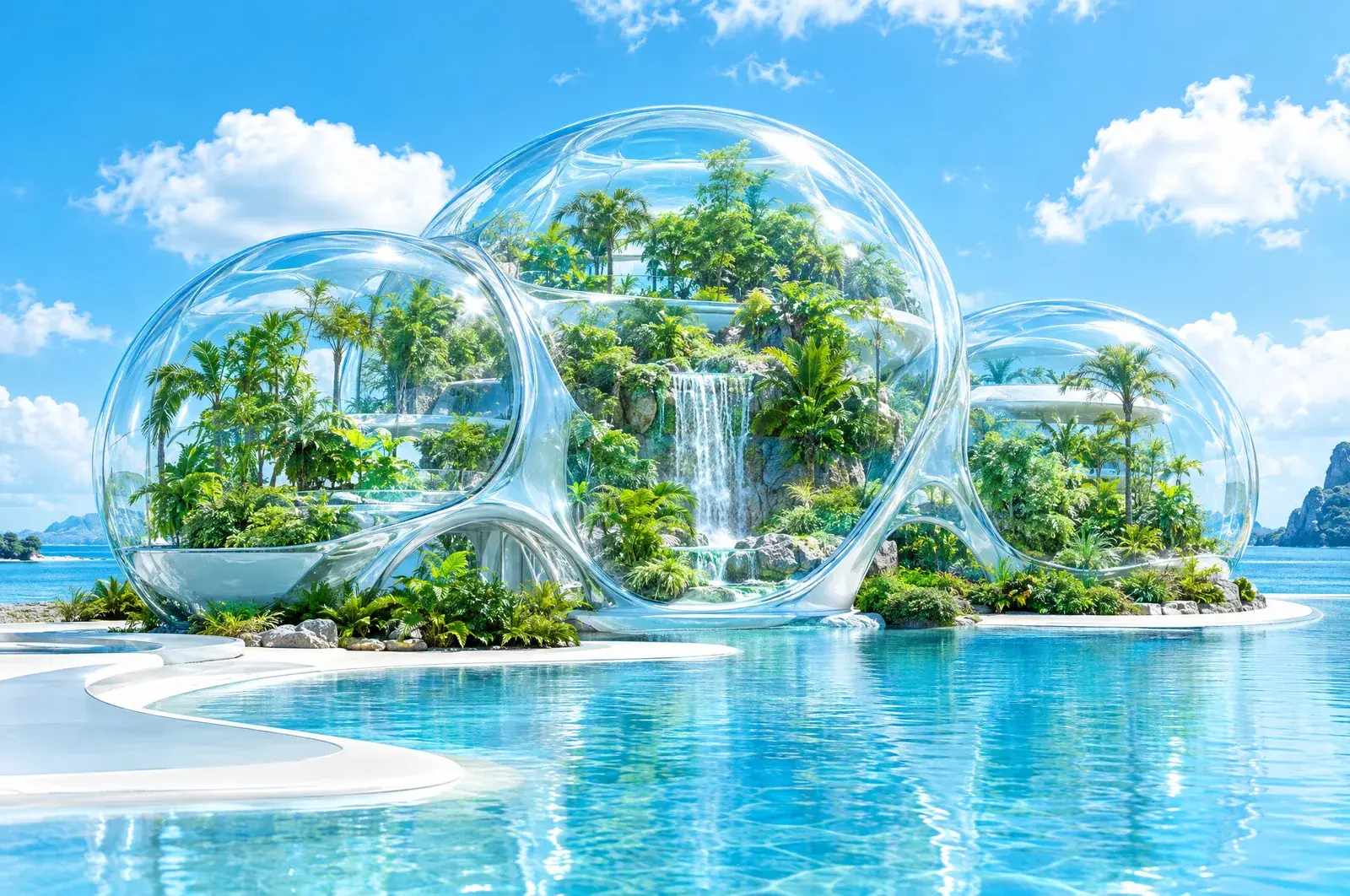
The picture I keep in my head is not a cold metal future. It is a rounded, sunlit one: gardens on the roofs, glass domes with waterfalls inside, clean energy, and helpful machines that are as unthreatening as a friendly dolphin. That is the world described in what is solarpunk and drawn in the Frutiger Aero era, and I explore what it looks like in buildings in round, not square.
The dolphin is a good image for me, because it stands for an intelligent, wild animal that is friendly to people without being owned by them or ruling them. That is what I mean by harmony: not a servant and not a master, but a partner, with each side getting something. Whether AI becomes that depends on choices we are making right now, which is why I would rather spend my energy on making good ones than on predicting the ending.
If you are wary
You do not have to like AI. Caution is reasonable, and I would rather you use it slowly and carefully than not at all or all the time. If you want to talk about it with people who are curious and unhurried, the ADHD MindFlow community is a good place to do that. And if the whole subject makes your head buzz, a few minutes with a listening session is a gentle way to come back to the ground.
A personal view and a hope, not a prediction. Sources are linked, and I have tried to give the concerns as much room as the promise.
Personal view, with sources linked so you can check the numbers yourself. Read our sources, commercial disclosure and editorial approach.
Follow your curiosity.
 Nature & technology
Round, not square: biodomes, curved buildings and why nature has so few boxes
Nature builds in curves, spirals and domes. We built our world in rectangles. Here is the case for building round, what the Eden Project, Biosphere 2 and Gardens by the Bay actually teach us, and what the evidence says about living near nature.
7 min read The future
What is solarpunk? The optimistic future, and what is already real
Solarpunk imagines a future where clean energy, nature and community fit together. It began as a 2008 blog post and became an art, fiction and design movement. Here is what it means, what is already real, and where it falls short.
5 min read Energy & home
Solar is now the cheapest electricity we have ever made: the numbers, and their limits
Solar power fell about 90% in cost between 2010 and 2024, and in 2025 renewables overtook coal for the first time in a century. Here are the checked numbers, what they mean, and what they do not.
5 min read