
Growing food in cities: the promise of vertical farms, and what Singapore learned
Towers of lettuce look like the future. Singapore bet big on them, then dropped its 30 by 30 food goal in 2025. Here is what actually happened, what works at home scale, and how to start growing something this week.
In this story
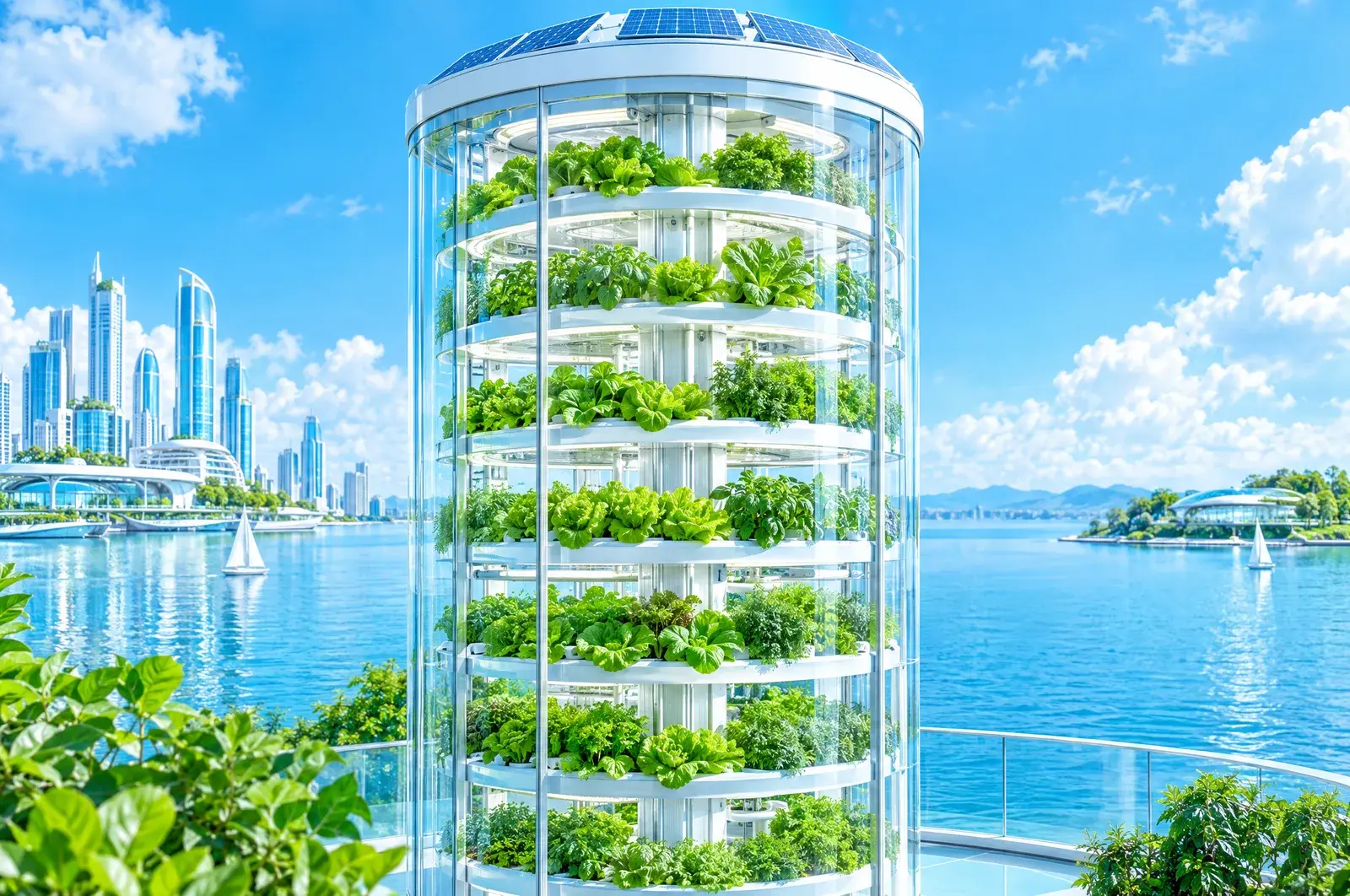
A glass tower stacked with lettuce is one of the most popular images of the green future. It is also a good test of how hopeful ideas meet money and physics. Singapore tried it more seriously than almost anyone, and its experience is worth reading closely.
I love the picture as much as anyone. It is in one of the illustrations at the top of this page. But I promised myself I would write about hopeful things honestly, which means telling you where they wobble. This is a good story for that, because the good news and the bad news are both real.
Why anyone wants to farm in a city
The logic is appealing. Cities import most of their food, often over long distances. If you could grow salad leaves, herbs and vegetables next to where people eat them, you would cut transport, waste and dependence on distant supply. In a vertical farm you grow crops in stacked layers under artificial light, often in water instead of soil, in a controlled indoor environment that does not depend on weather. You can grow all year and use less water than a field.
What Singapore attempted
Singapore has almost no farmland and imports the great majority of its food. In 2019 it announced a goal known as "30 by 30": to produce 30% of its nutritional needs locally by 2030. Vertical and high-tech farms were a central part of the plan, and the government backed them with grants. One example is the 30x30 Express fund announced in 2020, which shared around S$39 million among nine companies.
What happened
In November 2025 the government said it was dropping the 30 by 30 goal. The reasons given were the high cost of land, labour and energy. According to reports of the announcement, Singapore's local food production had stayed below 10% despite the effort. It replaced the overall target with narrower ones for 2035: 20% of the fibre (vegetables, mushrooms and sprouts) and 30% of the protein (eggs and seafood) that Singapore eats. The Ministry of Sustainability and the Environment set out its position in a written reply to a parliamentary question, and Mothership has a readable summary. In 2024, according to the Singapore Food Agency, the country produced about 8% of its fibre and 26% of its protein.
Some of the high-tech farms did not survive. The indoor farm IFFI, one of the companies that shared the 30x30 Express grant, built a large facility in 2021 and closed it in 2024, and another long-running farm, Sky Greens, scaled back. Vertical Farm Daily reported both.
Why it is so hard
I should be careful to say that I am reasoning from the reported reasons, not from inside knowledge of any of these businesses.
- Energy. Plants need light, and if the light is electric, you are paying for the sun. That works better when the electricity is cheap and clean, which is one reason cheap solar is so relevant.
- Land and labour. A city building is expensive, and running a farm takes skilled people.
- Narrow crops. Vertical farms grow leaves and herbs well. Wheat, potatoes and rice, which supply most of the calories people eat, are far harder to grow indoors economically.
- Competition from cheap imports. Field-grown vegetables are cheap, and shoppers compare prices.
None of that means vertical farming is pointless. It means it is a niche that works in some conditions, not a replacement for farms.
What does work
Growing food in cities is not only about towers. Some of the most productive urban food-growing is very low-tech:
- Allotments and community gardens. Shared plots where neighbours grow vegetables, swap seeds and knowledge, and meet each other.
- Balcony and windowsill growing. Herbs, salad leaves, cherry tomatoes and chillies do well in pots.
- Rooftop and school gardens.
- Composting. Turning food scraps into soil closes a small loop.
The measurable benefit here may be less about calories and more about people. There is some evidence that time in gardens and green spaces is linked with better mental wellbeing. A 2024 systematic review and meta-analysis found that access to gardens was associated with lower odds of depression and anxiety, though the authors rated the quality of the evidence as very low, so I would treat it as encouraging, not settled.
Why I like it for a busy mind
Growing something is one of the best projects I know for an ADHD brain. It is physical, it gives feedback fast (a seed sprouts in days), it has a natural rhythm without a deadline, and it rewards small regular attention. It is a very gentle way to practise the daily routine that so many of us find hard. If you are working on replacing a habit with something good, what replaces the weed has this in its list.
Start this week
You do not need a tower. Here is the smallest possible version:
- Pick one thing you like to eat. Basil, mint, salad leaves, chives.
- Get a pot and some compost. Any container with a hole in the bottom will do.
- Put it near a window that gets light. A south-facing sill is best in the northern hemisphere.
- Water it when the top of the soil feels dry.
- Look at it every day. That is the habit. It takes ten seconds.
If it dies, you have learned something, and you can try again for the price of a packet of seeds.
The lesson I take from Singapore
I do not read this as a failure of hope. I read it as a reason to be specific. A good idea has to survive contact with costs. The way to build the future we like is to try things, measure them honestly, drop what does not work, and keep what does. That is not pessimism, it is how progress usually happens.
For the wider picture, see what is solarpunk, and for another practical place to start, plug-in solar. If you would like to swap growing tips with other people, the ADHD MindFlow community is a friendly place, and a few minutes with a listening session makes a good start to a gardening morning.
A personal view, with sources linked. Figures are as reported by the sources named.
Personal view, with sources linked so you can check the numbers yourself. Read our sources, commercial disclosure and editorial approach.
Follow your curiosity.
 The future
What is solarpunk? The optimistic future, and what is already real
Solarpunk imagines a future where clean energy, nature and community fit together. It began as a 2008 blog post and became an art, fiction and design movement. Here is what it means, what is already real, and where it falls short.
5 min read The future
Solarpunk cities that already exist: Vauban, Copenhagen, Medellín and Curitiba
You do not need to wait for the future to see cities that work differently. Four real places, what they actually did, the numbers reported, and the honest limits of each story.
6 min read The future
The Frutiger Aero timeline: the optimistic future that almost was
Glossy glass, water droplets, blue skies and friendly technology. Frutiger Aero was the look of a hopeful future from about 2005 to 2013. Here is the timeline, where the name comes from, why it faded, and why it is back.
6 min read