
Eclipses explained: why they come in pairs, and the total eclipse of 2 August 2027
Eclipses follow a tidy rhythm set by the Moon's tilted orbit. Here is why we do not get one every month, what happened on 12 August 2026, and where to see the longest totality of the century in 2027.
In this story
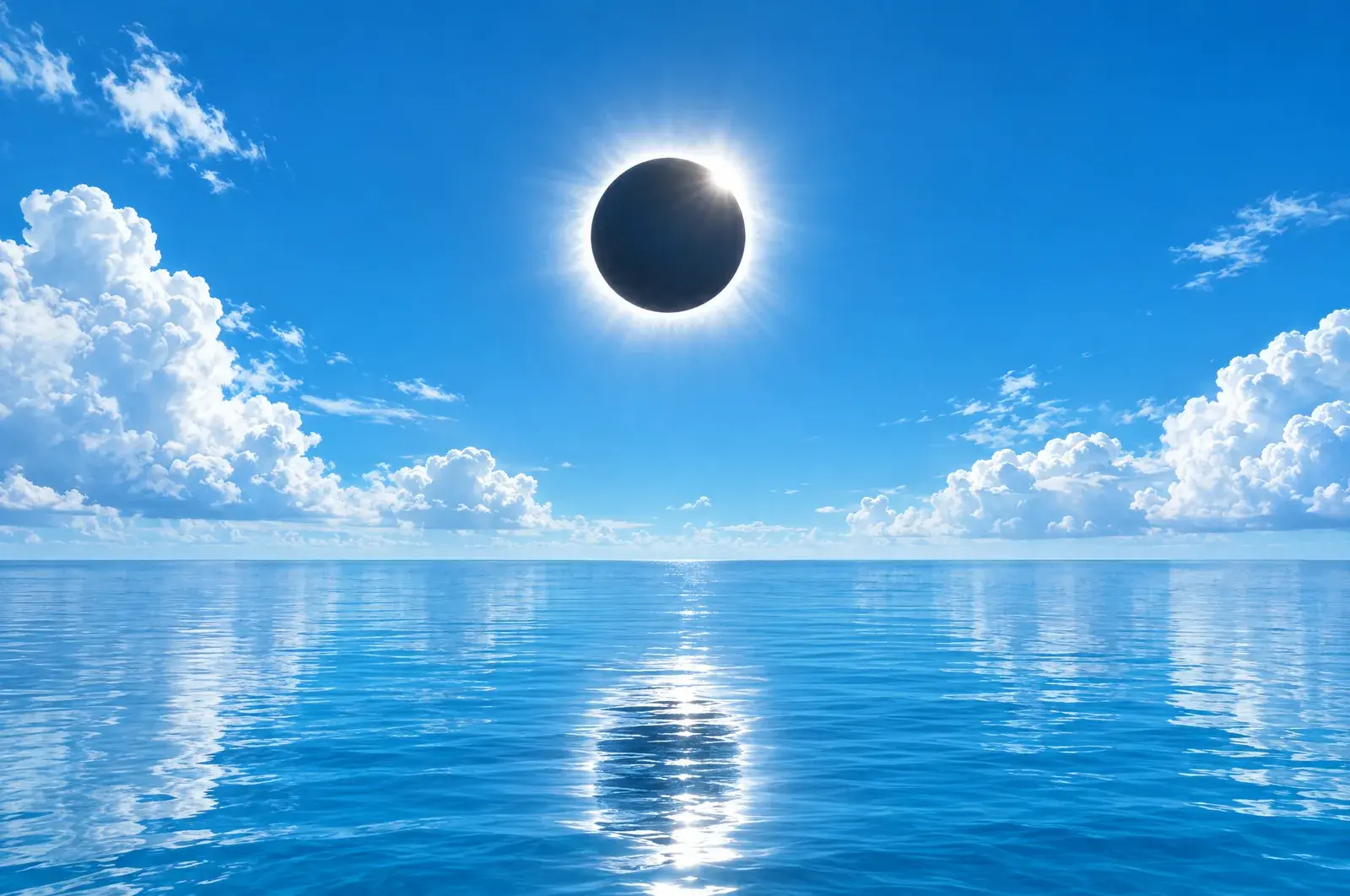
A solar eclipse happens when the Moon passes directly between Earth and the Sun. We do not get one every month because the Moon's orbit is tilted, so most new moons pass just above or below the Sun.
Eclipses are one of the few astronomical events that make almost everyone stop and look up. They are also one of the most predictable, and the rhythm behind them is worth understanding, because it makes the next one easy to find.
Why not every month
The Moon goes around Earth roughly once a month, so every month there is a new moon (the Moon between us and the Sun) and a bright, round moon on the opposite side of Earth from the Sun. If its orbit were in the same flat plane as Earth's orbit around the Sun, we would have an eclipse at every new moon (the Moon covering the Sun) and every bright round moon (Earth's shadow covering the Moon).
But the Moon's orbit is tilted about 5 degrees to Earth's. So most months the new moon passes a little above or below the Sun, and the bright round moon a little above or below Earth's shadow. Nothing lines up. EarthSky has a clear explanation of this.
Nodes and eclipse seasons
The two orbits cross at two points called the lunar nodes. An eclipse can only happen when a new moon or a bright round moon is close to a node. The Sun's position along the ecliptic meets a node roughly every 173 days, and that sets up an eclipse season, a window of about 34 to 40 days when eclipses are possible.
Because the seasons are about six months apart, eclipses arrive in bursts. In one eclipse season you can get a solar eclipse and a lunar eclipse about two weeks apart, and sometimes a small extra. In a calendar year there are at least four eclipses in total, and up to seven.
Astrology's nodes
In astrology the lunar nodes are called the North Node and South Node, or Rahu and Ketu in Vedic astrology. It is a lovely example of an astronomical thing that astrology has kept and given its own meaning. The astronomy is that the nodes are simply where the Moon's path crosses the Sun's path. What the nodes "mean" is a tradition, and I treat it as one.
Total, annular, partial
- Total: the Moon is close enough (large enough in the sky) to cover the whole Sun. The sky darkens, temperatures drop, and you can see the Sun's outer atmosphere, the corona.
- Annular: the Moon is too far away to cover the Sun completely, so a ring of the Sun's surface stays visible. It is never safe to look at without eye protection.
- Partial: the Moon covers only part of the Sun.
Only the total phase is safe to look at without filters, and only during totality itself. At every other moment you need certified eclipse glasses, or an indirect method such as a pinhole projector.
12 August 2026: the one that just passed
Almost seven weeks ago, on 12 August 2026, a total solar eclipse crossed Greenland, Iceland, the Atlantic, northern Spain and a small corner of Portugal. It was the first total eclipse over continental Europe since 1999, according to NASA. The longest totality was about 2 minutes 18 seconds, off the west coast of Iceland. In Spain the Sun was low in the sky and the eclipse happened shortly before sunset, so many people watched it near the horizon.
The next one: 2 August 2027
If you missed this year's, the next total eclipse is only a year away and it is a big one. On 2 August 2027 the path of totality begins in the Atlantic, crosses the Strait of Gibraltar and the southern tip of Spain, then follows the North African coast into Egypt, crosses the Red Sea, and passes over parts of Saudi Arabia, Yemen and Somalia before ending in the Indian Ocean.
The headline is the duration. Totality lasts about 6 minutes 23 seconds near the point of greatest eclipse, in Egypt. That is the longest total eclipse anyone will be able to see from easily accessible land until 2114. Spain's national geographic institute has a good page on the 2027 eclipse, and Wikipedia has a detailed summary.
If you are thinking of going, here are the practical points I would look at first:
- Be inside the path. A partial eclipse a few kilometres outside the path of totality is a very different experience from totality.
- Book early. Hotels along the path fill up long before the date.
- Pick a place with good August weather. Clear skies matter more than anything.
- Buy certified eclipse glasses well before the day, from a reputable seller.
Why eclipses feel special
For a few minutes the world changes. The light goes strange, animals go quiet, and the temperature drops. It is a very physical reminder that we live on a planet, orbiting a star, next to a moon, and that these three are all moving in a way we can calculate to the second.
For an ADHD mind, that kind of concrete wonder is a very good reset. The attention it asks for is effortless, the opposite of forcing yourself to focus. If you want to build more of that into your week, a short walk outside at an odd hour of the day does something similar in a small way.
What astrologers say
In astrology, eclipses are read as turning points, times when things are revealed or endings and beginnings arrive more sharply. It is one of the oldest and most cited ideas in the tradition. I make no claim that an eclipse causes events in your life, and I treat the reading as a prompt for reflection. If you want to see which of your own placements fall near an eclipse, your chart can show it, and my Solar Blueprint reading writes it up in the sky you choose. I write and check every reading myself.
To share where you watched from, or plan a trip with other people, the ADHD MindFlow community is open. For the seasons that frame all this, see solstices and equinoxes.
Astronomy facts here are checked against the sources linked. Astrology is a way to reflect, not science, and it does not predict events.
Astrology is a way to reflect, not science, and it does not predict events. Astronomy facts here are checked against the sources linked. Read our sources, commercial disclosure and editorial approach.
Follow your curiosity.
 Astronomy
Why the zodiac drifted: axial precession, explained without the maths
Earth wobbles like a slowing top, and that wobble has moved the seasons against the stars by about 24 degrees. Here is how precession works, who found it, and what it changes for astrology and the pole star.
5 min read Astronomy
Solstices and equinoxes: what the Sun is actually doing, and the 2026-27 dates
The four turning points of the year are about Earth's tilt, not distance from the Sun. Here is what a solstice and an equinox really are, the exact dates for 2026, and why the seasons and the zodiac line up.
4 min read Astronomy
Retrograde explained: what a planet "going backwards" actually is
Mercury does not really move backwards. Retrograde is a trick of perspective, like one car overtaking another. Here is how it works, how often it happens, and the next dates.
4 min read